
What PK Really Means on an Air Conditioner Label
PK is a size class, not a measure of cooling. What the label really tells you, and why an oversized unit leaves a room cool but damp.
Almost every air conditioner conversation in Indonesia begins with the same question: how many PK? It is convenient shorthand, and it is also the most misread number in the category. Buyers treat the PK rating as a strength score, assume the larger number is the safer choice, and pay for that assumption twice — once at purchase, and again on every electricity bill afterwards.
The habit follows the number out of the showroom and into purchase orders and tender documents, where one line of specification quietly decides what an entire building's worth of rooms will get. What follows is what that number actually describes, what to read instead, and how to write it down so the machine that arrives is the one you sized.
PK is a size class, not a cooling measurement
PK comes from paardenkracht, the Dutch word for horsepower, and it entered this market as a description of the compressor motor rather than of the air the machine cools. One metric horsepower is roughly 735 watts of mechanical power — a statement about a motor turning inside the outdoor unit, not about how much heat leaves your room.
What you are actually buying is cooling capacity: the heat the machine can move out of a space in an hour. On the rating plate it appears in BTU per hour, in watts, or both, and the two convert cleanly — one kilowatt of cooling is about 3,412 BTU per hour — so a unit rated in kilowatts can be compared directly with one rated in BTU.
PK survives as a showroom size class, not as a measured property of the machine in front of you. The conventional bands are worth carrying in your head, because they tell you at a glance whether two offers are even in the same territory: half a PK sits around 5,000 BTU per hour, one PK around 9,000, one and a half around 12,000, and two around 18,000. Treat those as landmarks, not specifications. Models inside a single class differ by hundreds of BTU per hour, brands draw the boundaries differently, and that gap is real cooling rather than marketing. When the class and the capacity figure seem to disagree, believe the capacity figure — it is the one that was measured.
Two figures in watts, and only one of them is your bill
The same plate carries a second number in watts: the electrical power the unit consumes. Seeing two figures in watts, most people assume one is a misprint. They are different quantities. One is heat removed from the room; the other is electricity you pay for.
The ratio between them is the efficiency of the machine, printed as EER or COP — capacity divided by input power. An air conditioner moves far more heat than the energy it consumes, because it does not manufacture cold; it pumps heat from inside to outside. Two units in the same PK class, cooling the same room equally well, can differ noticeably in the watts they draw to do it, and that difference repeats every hour the machine runs. Input power is also the one number on the plate you can turn straight into money: rated input in kilowatts, multiplied by the hours the unit will really run, multiplied by your electricity tariff. For equipment that runs all day, the answer often dwarfs the difference in purchase price.
One clarification prevents a common mistake. The star label on air conditioners sold here is not that plate ratio. It is calculated from a seasonal figure, CSPF, measured across a range of loads and outdoor conditions rather than at a single full-load test point. A unit with a strong plate EER therefore does not automatically carry more stars, and a machine that looks ordinary at full load can win across a season by running gently at part load — which is where most units spend most of their hours. Read the stars and the plate as answers to two different questions, and do not convert one into the other.
Rated capacity is measured under defined test conditions as well. The hotter the outdoor air, the harder the machine has to work to reject heat into it, and the less capacity is left for the room. A rating is a fair way to compare two products with each other. It is not a promise about the worst afternoon of the year.
Why an oversized unit leaves a room cool but damp
Fitting a much larger unit than the room needs does not simply waste money. It can leave the room less comfortable than a smaller one would.
An air conditioner does two jobs at once: it lowers air temperature, and it removes moisture. How much moisture it removes depends on how long the coil stays cold and wet. Water condenses out of the air passing over the coil and drains away, and that takes running time. A machine sized close to the load runs long, steady cycles and pulls a great deal of water out of the air along the way. Dry mode does not change this arithmetic — it slows the fan so the coil runs colder and wetter, which genuinely helps, but it cannot give a compressor that keeps switching itself off the running hours that dehumidifying needs.
An oversized machine reaches the setpoint quickly and stops, before the coil has been cold and wet for long. The room ends up cool and clammy. Damp air feels warmer and stickier than dry air at the same temperature, so the occupant does the obvious thing and pushes the setpoint lower — which is exactly the instruction that raises consumption. The machine was never short of power; it was too powerful to dehumidify properly. In a climate as humid as this one, that is not a marginal effect.
Short cycling costs on the mechanical side too. A fixed-speed compressor draws a surge of current every time it starts, well above its running current, and each cycle spends its opening minutes before pressures and temperatures settle — its least efficient minutes. More starts per hour means more of those minutes, and more wear on the parts doing the starting.
Does an inverter fix this? Partly. An inverter compressor varies its speed instead of switching between full power and off, so a load below its maximum makes it throttle down and keep running gently — the behaviour that both saves energy and keeps the coil cold long enough to dehumidify. That honestly softens the penalty for buying slightly large. But every inverter compressor has a minimum speed, and below that it cycles like any other machine: a badly oversized inverter still short cycles in small rooms and on mild days, while its owner pays for capacity that never gets used. Two things follow. On an inverter spec sheet the PK class tells you even less, because the real specification is a capacity range — a rated figure with a minimum and a maximum around it, and the minimum is the interesting end. And an inverter starts gently rather than surging, which matters where the contracted electrical supply is tight and a hard start trips the limiter.
Undersizing is not the clever alternative either. A unit that can never reach setpoint runs at full power all day and still leaves the room warm. The target is not small. The target is matched.
Sizing starts with the room, not the price list
Floor area is where sizing starts, and only where it starts. A common opening estimate in this market is roughly 500 to 600 BTU per hour for every square metre of floor, for an ordinary room with a normal ceiling and nothing unusual going on inside it. Treat that as a way to decide which class to look at, not as a specification. It stops being true the moment the room stops being ordinary.
What pushes the number up, roughly in order of how much it matters:
Sun on the walls and windows. Afternoon sun pours heat inward for hours, and unshaded glass is close to an open invitation.
A room under the roof. It absorbs heat from above all day and keeps releasing it into the evening.
Ceiling height. You are conditioning a volume, not a floor.
People. Each occupant gives off heat continuously — roughly at the rate of a small incandescent bulb — plus moisture. A meeting room with twelve people in it is a different job from the same room with one.
Equipment and lighting. Computers, kitchen gear and chargers all end up as heat in the room; a rack of equipment is a heater that happens to compute.
Doors and openings. A door that opens constantly, or a room open to a hot corridor, keeps importing outside air that must be cooled and dried from scratch.
Insulation, or the lack of it. It decides how much of the outdoor heat ever gets in at all.
Two rooms with identical floor areas can land a full class apart on that list, which is why a rule based on area alone produces confident wrong answers. For anything beyond a bedroom or a small office — a shop floor, a glass frontage, a room full of equipment — take the measurements to your supplier or installer and ask for a load calculation instead of a rule of thumb. What they need is unglamorous and you already have it: dimensions and ceiling height, which way the windows face and how much glass there is, what sits above the ceiling, how many people occupy the room, and what equipment runs in it.
Specifying it so quotes can be compared
If you buy for more than one room — offices, a shop floor, rented units, several branches — the specification you send out matters as much as the one you read. A line that says only 1 PK invites three suppliers to quote three genuinely different machines and call it the same thing. Numbers make the offers comparable:
Cooling capacity in BTU per hour or watts, with the tolerance you will accept.
Maximum rated power input in watts — without it, the cheapest offer can win by drawing more.
Capacity range where inverter units are acceptable: minimum and maximum, not the rated figure alone.
Electrical supply as it exists on site: voltage and phase.
Scope of works: pipe run length, brackets, drain, and who supplies what.
That last line is not housekeeping. A correctly sized unit can still be crippled on site. Refrigerant pipe has a specified maximum run, and long runs with extra bends cost capacity; split units are commonly pre-charged for a run of only a few metres — often around five — with the manufacturer stating how much refrigerant to add per additional metre. A long run that nobody priced becomes either an extra invoice or a quiet loss of performance. The outdoor unit needs clear space to throw heat away, too: box it into a tight service well and it re-inhales its own exhaust, condensing temperature climbs, capacity falls and consumption rises.
One more habit is worth keeping. Where the rooms allow it, specify the same model across sites rather than whatever is cheapest that week. Fewer models across more units means technicians who already know them, spares that fit more than one machine, and a running cost you can work out once instead of ten times.

On the day it arrives
The most avoidable losses in this category happen in the few minutes before someone signs for the delivery, and they are far easier to settle while the driver is still there.
Look at the cartons first — crushed corners, punctures, water marks — and write what you see on the delivery note rather than signing clean and calling afterwards. Then check that the model number and serial number on the unit's rating plate match the carton label and the paperwork. Plates and cartons disagree more often than people expect, and a split system carries two of them, one on the indoor unit and one on the outdoor unit, which belong together as a pair. Confirm that the capacity and the voltage are the ones you specified, not the class you assumed.
Photograph the rating plate before anything goes up on a wall. That plate is the document that settles later questions, and it is the hardest thing in the building to read once the unit is three metres above the floor. Keep the serial numbers recorded against the room each unit was installed in; the day a service visit or a claim comes up, that list is the difference between a five-minute answer and an afternoon on a ladder.
The short version
PK tells you which shelf a machine sits on. Capacity tells you what it removes, input power tells you what it costs, and the room tells you which capacity you need.
Bigger is not safer. Matched is safer — and matched is usually cheaper to run.

6 Oktober 2026
Water Heater 10, 15, atau 30 Liter: Mana yang Paling Sesuai untuk Rumah Anda?
Bingung memilih water heater 10, 15, atau 30 liter? Pelajari perbedaan kapasitas dan kebutuhan pengguna, lalu temukan rekomendasi water heater yang se
5 Oktober 2026
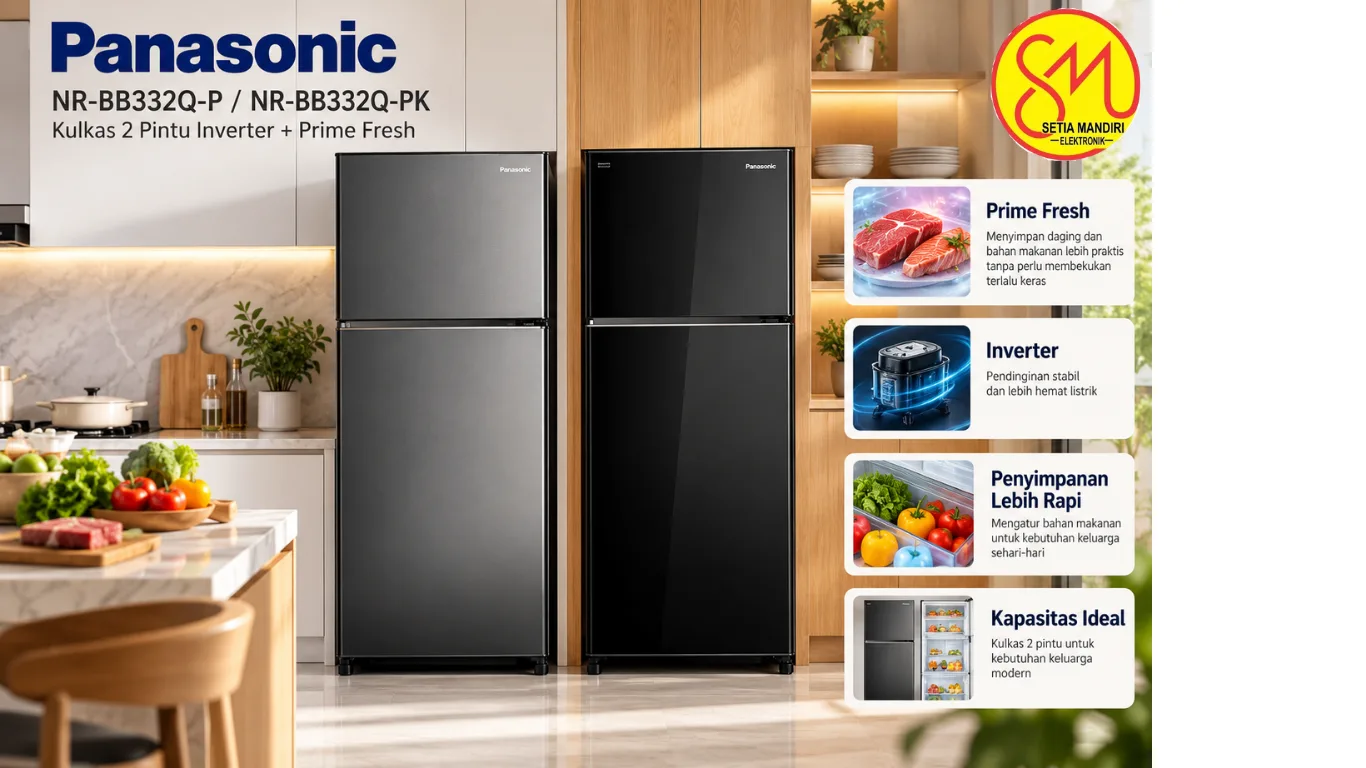
Panasonic NR-BB332Q-P / NR-BB332Q-PK: Kulkas 2 Pintu Inverter dengan Prime Fresh untuk Kebutuhan Keluarga
Kenali Panasonic NR-BB332Q-P / NR-BB332Q-PK, kulkas 2 pintu inverter dengan Prime Fresh untuk membantu menjaga kesegaran bahan makanan. Simak fitur da

4 Oktober 2026
Mecoo Most Aesthetic Chopper 2-in-1: Bikin Persiapan Masak Lebih Praktis dan Dapur Makin Cantik
Kenali Mecoo Most Aesthetic Chopper 2-in-1, chopper elektrik untuk membantu mencincang daging, bumbu dan bahan makanan dengan lebih praktis.